
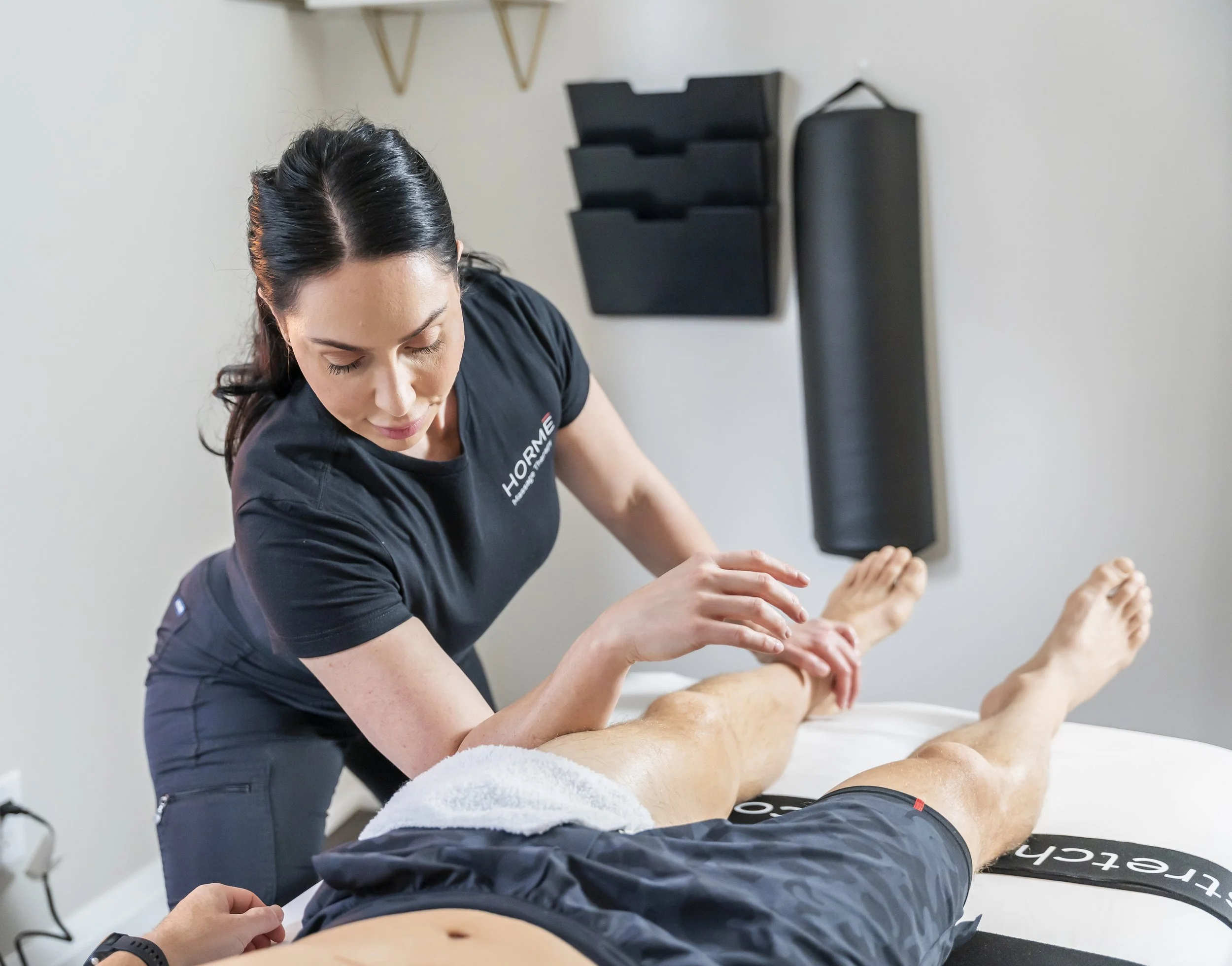
Therapeutic Treatments
Understand your body. Restore movement. Build resilience.
Pain, tightness and mobility restrictions don’t always exist in isolation. The place you feel the problem may be only one part of a larger pattern involving how your body moves, stabilizes, compensates and responds to load.
Therapeutic treatments look beyond the symptom.
Through assessment, hands-on treatment and movement, we’ll explore the factors that may be contributing to what you’re experiencing — including mobility, strength, joint function, posture, breathing and movement patterns.
Treatment may integrate Fascial Stretch Therapy, myofascial release, massage therapy, cupping, ELDOA and decompression techniques, assisted stretching, joint mobilization, mobility work and corrective exercise.
These modalities are tools, not a formula. The goal is to determine what your body needs and use the most appropriate strategies to help create meaningful change.
Just as importantly, you’ll learn what I’m seeing, why it matters and what you can do between sessions to support your progress.
The goal isn’t dependence on treatment. It’s greater understanding, movement capacity and long-term resilience.
A Whole-Body, Pattern Approach
Your body doesn’t move as a collection of isolated muscles and joints. Movement is coordinated across the entire system — and when mobility, strength, stability or control is limited somewhere, your body often finds another way to accomplish the task.
These compensations are adaptations, but over time they can contribute to inefficient movement, recurring tension, restricted mobility or increased stress elsewhere in the body.
That’s why I don’t only look at where you hurt.
I look at how you move.
Depending on your concern, assessment may explore posture, joint mobility, strength, breathing, balance and functional movements such as squatting, hinging, rotation and single-leg movement.
Fascia remains an important part of this picture. As a continuous connective tissue network, it plays a role in force transmission, movement and the relationship between different regions of the body. My background in fascia-focused therapy allows me to consider both tissue restrictions and movement patterns rather than viewing either in isolation.
What We’re Working Toward
Reduced pain and recurring tension
Improved mobility and movement options
Better strength, stability and load tolerance
More efficient movement patterns
Greater body awareness and understanding
Confidence managing your body outside the treatment room
Long-term physical resilience
The Resilient Body Framework
Assess. Treat. Rebuild.
My therapeutic approach has evolved through more than a decade of working with bodies through massage therapy, fascial work, stretching, fitness and movement.
Rather than treating a painful area in isolation or following a predetermined protocol, I look for patterns and relationships.
🔹 ASSESS
Understand the Pattern
We start by understanding what your body is currently doing.
Through your history, posture and functional movement assessment, I look at mobility, strength, stability, breathing and compensation patterns that may help explain why certain areas are becoming overloaded, restricted or symptomatic.
The goal isn’t to find something “wrong” with your body.
It’s to understand how your body has adapted — and where we may be able to give it better options.
🔹 TREAT
Create Opportunity for Change
Hands-on treatment can help reduce pain and tension, improve mobility and create access to movement that may currently be restricted.
Depending on what we find, treatment may include Myofascial Release, Fascial Stretch Therapy, massage therapy, cupping, ELDOA, decompression, joint mobilization and assisted stretching.
Fascia is an important part of this work, but it is considered alongside joints, muscles, movement, breathing and the demands being placed on your body.
Manual therapy creates an opportunity for change.
Movement helps us teach your body what to do with it.
🔹 REBUILD
Once we create access to better movement, we work on building the strength, control and confidence to use it.
Corrective exercise, mobility work, breathing strategies and progressive movement help reinforce new options and build your body’s ability to tolerate the demands of everyday life, work, training and sport.
You’ll leave with a clearer understanding of your body and, when appropriate, a focused home program designed around what we found — not a generic list of exercises.
We’ll reassess and progress as needed.
The goal is not perfect movement. It’s a body with more options, greater capacity and the resilience to adapt.
Your First Appointment
Every new client begins with a 75-minute Initial Appointment. This gives us time to understand your history and goals, assess what’s relevant to your concern, begin hands-on treatment and establish a direction for care.
If you’re coming in for pain, mobility, injury recovery or performance concerns, your assessment may include posture and functional movement as well as more specific testing based on what we observe.
We’ll use those findings to guide treatment rather than forcing your body into a predetermined protocol.
From there, recommendations are individualized. Some clients benefit from a short series of Therapeutic Treatments, while others need only occasional follow-ups alongside independent movement and home care.
The aim is to give you the support you need — not more treatment than you need.

Interview
Review of your health history and goals for treatment

Assessment
Postural analysis and movement assessments

Treatment Plan
A series of carefully designed sessions according to your health needs & goals

Movement
In-office and home protocols designed to restore movement, eliminate pain and build resilience
Who This Is For
Therapeutic Treatment may be a good fit if you’re experiencing:
Persistent or recurring pain and tension
Mobility or flexibility restrictions
Movement limitations or recurring compensation patterns
Postural concerns
Injury recovery
Difficulty returning comfortably to activity
Athletic or performance-related movement concerns
A desire to maintain mobility, strength and physical independence as you age
You don’t need to know what’s causing the problem before you come in.
That’s what the assessment is for.
Together, we’ll work toward understanding your body, improving the way it moves and building the capacity to keep doing the things that matter to you.
Modalities I use
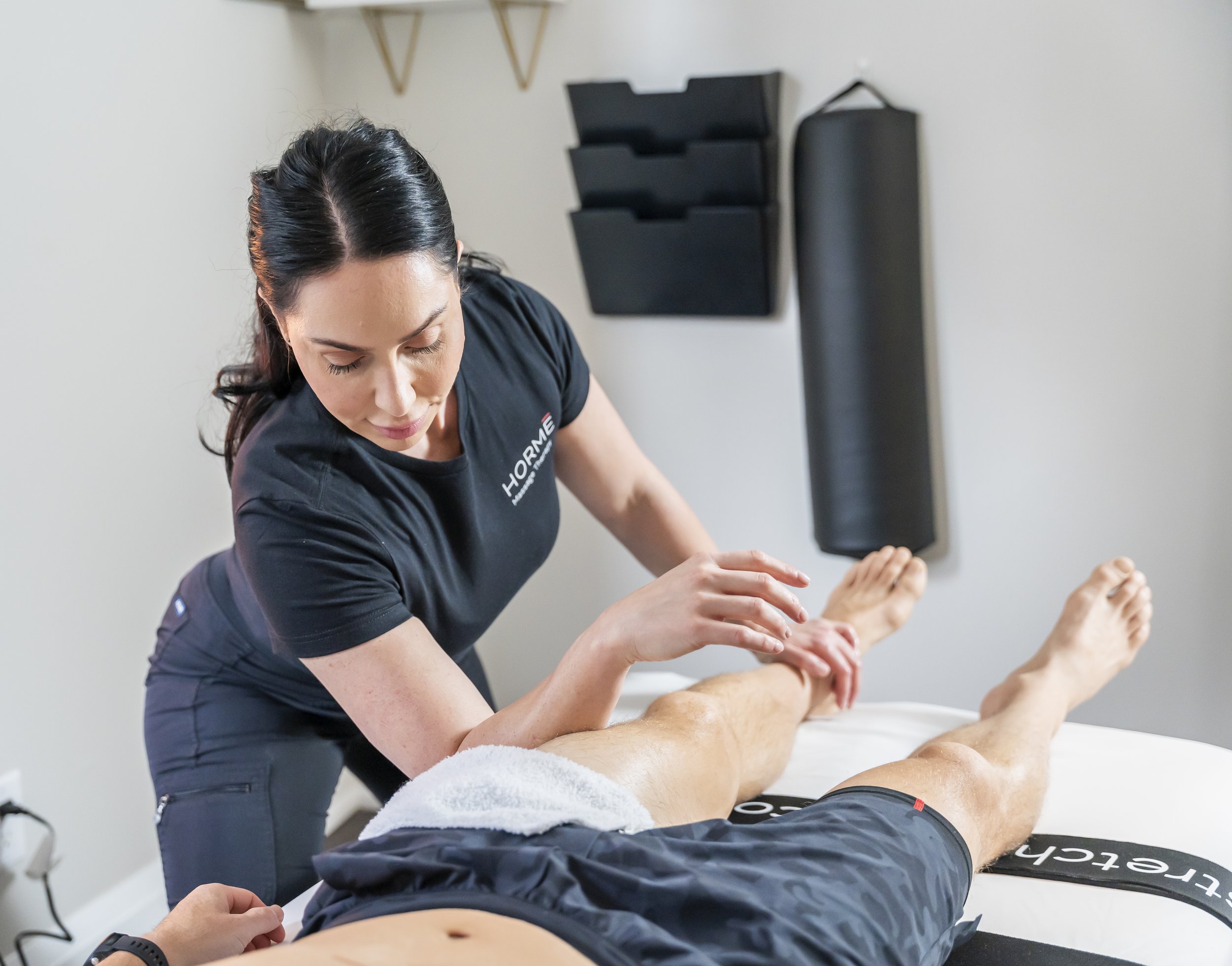
In addition to manual myofascial release techniques, your treatment plan may include the use of various modalities, each customized to you. The expected benefits and risks of each modality will be discussed with you and will never be used without your consent.
All modalities offered are included in the RMT scope of practice. Click below to learn more.


Conditions I Treat
Scoliosis
TMJ Dysfunction- Intra Oral
Thoracic Outlet Syndrome
Arthritis
Chronic pain
Sprains
Strains
Movement Restrictions
Postural Imbalances
Muscle Imbalances
Tendinitis; Golfer’s Elbow, Tennis Elbow
IT Band Syndrome
Patella Femoral Syndrome
SI Joint Pain
Frozen Shoulder
Headaches
Trigger Points
Plantar Fasciitis
Carpal Tunnel
Nerve Impingement/Compression
Sciatica
Piriformis Syndrome